Visual ability is not simply about how clearly you see. It is also about how well your eyes work together and how effectively your brain interprets visual information.
Vision therapy is a personalized program of eye exercises, activities, and therapeutic procedures designed to improve how the eyes work together with the brain. Glasses compensate for refractive errors, whereas vision therapy addresses functional deficits from which fatigue or strain results.
Optical capture of light and image data from the physical environment.
Synchronized muscle tracking, convergence, and precise binocular alignment.
Neurological pathways integrating signals from both eyes into a single clear feed.
Comfortable depth perception, reading stamina, and accurate spatial awareness.
Training the ocular muscles to align smoothly, preventing double vision and convergence insufficiency during close work.
Enhancing the speed and flexibility with which eyes shift focus between near screens and distant objects.
Strengthening smooth pursuit and saccadic movements essential for effortless reading without skipping lines.
Developing the brain's ability to interpret, remember, and rapidly organize complex visual information.
Some individuals may experience persistent fatigue, headaches, or reading difficulties even when their standard 20/20 visual acuity or prescription glasses seem correct.
May benefit when struggling with reading stamina, letter reversals, or short attention spans during near work.
May be considered for persistent digital eye strain, end-of-day eye fatigue, and sustained focus demands.
Helps address visual-spatial and tracking difficulties that interfere with classroom performance.
Supports individuals with convergence insufficiency where the eyes tend to drift outward during reading.
Assists patients with accommodative spasm or infacility who experience transient blur when looking up.
May support visual rehabilitation after traumatic brain injury, concussion, or neurological events.
Vision therapy offers targeted non-surgical therapeutic approaches for functional eye conditions diagnosed upon thorough evaluation.
Strengthening neuro-visual pathways to encourage the brain to properly use the weaker eye alongside the dominant one.
Non-surgical therapeutic exercises to enhance eye alignment, binocular fusion, and coordinated tracking where indicated.
Restoring accommodative flexibility and stamina, easing rapid focus changes between near reading and distance vision.
Managing convergence insufficiency, diplopia, and uneven tracking to ensure both eyes work as an integrated team.
Improving visual tracking, directionality, and spatial memory to reduce fatigue during extended academic work.
Relieving digital ocular fatigue, dry eye-related muscle strain, and blurred screen vision caused by intensive device use.
Neuro-optometric rehabilitation for light sensitivity, motion discomfort, and visual instability following head trauma.
Vision therapy programs in Lucknow are customized based on clinical severity, patient age, and lifestyle requirements.
Supervised clinical sessions involving trained optometrists and vision therapists utilizing specialized optical instruments, diagnostic lenses, and personalized training protocols.
Prescribed therapeutic exercises performed independently at home, supplemented by scheduled periodic clinical reviews to monitor functional progress and adjust difficulty.
Modern vision therapy software and virtual reality-based tasks designed to enhance visual processing, reaction times, and binocular motor fusion through gamified visual activities.
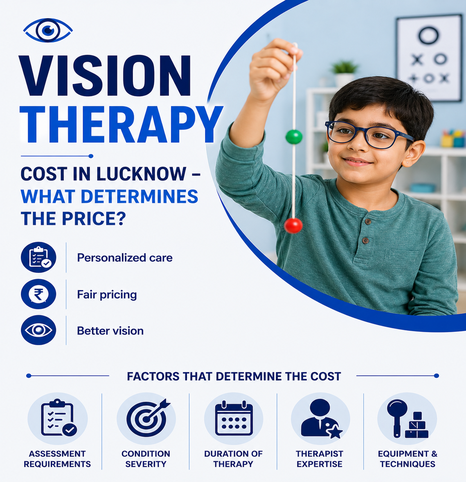
The overall investment for vision therapy in Lucknow depends on the complexity of the underlying visual problem, course duration, and technological modalities required.
More complex conditions such as amblyopia, strabismus, or learning-related visual processing deficits require a longer and more intensive treatment course.
Most clinical programs range from approximately 8 to 24 weeks, comprising weekly or bi-weekly guided sessions and continuous progress re-evaluations.
Sophisticated diagnostic facilities, computerized visual treatment modalities, and virtual reality-based exercise systems influence the program structure.
The qualification and dedicated experience of the optometrist and vision therapist directly influence the precision of diagnosis, individualized care planning, and long-term functional recovery.
When seeking vision therapy care, look beyond cost alone and consider these six fundamental standards:
Specialized training and clinical focus in binocular vision and functional visual rehabilitation.
Availability of accurate binocular testing, accommodative testing, and oculomotor tracking tools.
Individualized treatment paths rather than generic one-size-fits-all exercise routines.
Supportive, engaging clinical atmosphere designed to keep pediatric patients motivated.
A proven history of successfully helping children and adults overcome functional visual deficits.
Transparent communication regarding milestones, expected timelines, and therapy goals.
Vision therapy is generally not included in standard health insurance packages in India because it is classified as non-surgical rehabilitative care. However, specific coverage may apply in certain neurological or post-traumatic circumstances.
Inquire directly regarding coverage for neuro-optometric rehabilitation or post-trauma visual therapy.
Request itemized clinical documentation and diagnostic records for potential claim submission.
Enquire with the clinic regarding session-by-session or flexible milestone payment options.
Vision therapy is a step-by-step neuro-visual process with clear milestones from initial assessment to graduation.
In-depth evaluation of visual acuity, binocular coordination, tracking, stereopsis, and focusing flexibility.
One-on-one guided clinical session utilizing specialized prisms, filters, computerized software, and lenses.
Regular clinical appointments supplemented by brief, prescribed home exercises between visits.
Noticeable improvements in visual stamina, reading ease, reduced headaches, and focus switching.
Comprehensive post-therapy review to consolidate binocular habits and ensure permanent visual integration.
Vision therapy is recommended after an appropriate eye and visual-function assessment in scenarios such as:
When a child loses their place, skips words, or holds reading material abnormally close.
Noticeable eye drifting, intermittent double vision, or closing one eye while reading.
Difficulty with 3D perception, catching a ball, or judging spatial distances accurately.
When optical lenses correct clarity but visual strain, fatigue, and headaches persist.
Klarity Eye Care and Multispeciality Clinic (NABH Accredited) provides comprehensive examination and customized treatment programs for patients considering vision therapy.
If you or your child are experiencing focusing, coordination, tracking, or functional visual difficulties, a comprehensive assessment can help determine whether vision therapy is appropriate.