Retina Specialist in Lucknow
The retina transforms light into visual signals, while the uvea supports important blood-flow and immune functions within the eye. Conditions affecting these tissues can develop silently, making timely evaluation and specialist care important.
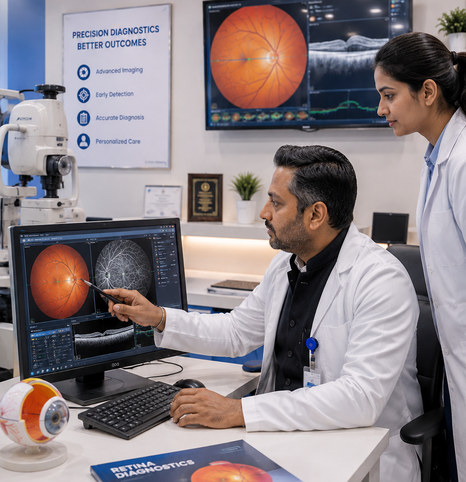
The Retina Turns Light Into Vision.
The retina is the thin layer of light-sensitive neural tissue which lines the back of the eye, while the uvea encompasses the iris, ciliary body, and choroid.
Because the retina and uvea are delicate and highly complex structures deep within the eye, ophthalmologists rely on advanced diagnostic imaging to evaluate cellular health, micro-vessel circulation, and inflammation. Most retinal and uveal diseases do not produce early warning symptoms, making periodic specialist examinations essential for protecting sight.
Light reaches photoreceptors at the eye's back.
Photoreceptors convert photons into neural impulses.
Optic pathways transmit sharp signals to the brain.
Some Retinal Conditions Begin Quietly.
The source page highlights primary retinal and uveal conditions that require detailed microscopic evaluation and timely ophthalmic management.
Diabetic Retinopathy
Microvascular damage to the retinal blood vessels caused by chronic elevated blood sugar, potentially leading to swelling, hemorrhages, and vision loss.
Retinal Detachment
A serious medical emergency where the light-sensitive retina pulls away or separates from its underlying supportive layer of blood vessels.
Age-Related Macular Degeneration (AMD)
Progressive deterioration of the central macula responsible for sharp, straight-ahead vision, presenting in dry or wet (neovascular) forms.
Macular Edema
Fluid buildup and swelling in the macula, often secondary to diabetes, vascular occlusions, or ocular inflammation, distorting fine visual detail.
Retinal Vein or Artery Occlusion
Blockage of the retinal vascular pathways (ocular strokes) interrupting oxygen and nutrient supply, causing sudden blurriness or acute vision reduction.
Uveitis (Uveal Inflammation)
Inflammation of the uveal tract (iris, ciliary body, choroid) that can cause deep pain, redness, photophobia, and risk to neighboring retinal layers.
Retinal Infections & Inflammatory Disorders
Infectious or autoimmune disorders affecting the posterior segment, requiring precise laboratory work-up and targeted antimicrobial or steroid therapies.
Know When Your Vision Is Sending a Signal.
Because retinal tissue cannot regenerate once damaged, paying attention to sudden or subtle visual disturbances is crucial for preserving lifelong sight.
Early diagnosis can significantly improve the opportunity for timely medical, laser, or surgical stabilization.
Sudden Loss or Change in Vision
Abrupt darkening, blurring, or a curtain-like shadow descending across any part of your visual field.
Floaters & Flashes of Light
Sudden appearance of dark spots, cobwebs, or brief flashes of light, indicative of vitreous traction or retinal tears.
Chronic Diabetes or Hypertension
Longstanding systemic conditions that necessitate mandatory routine retinal screening to prevent silent microvascular damage.
Persistent Redness & Photophobia
Ongoing deep ocular redness accompanied by severe light sensitivity and aching discomfort, common in uveitic episodes.
Treatment Depends on What the Retina Needs.
Retina and uvea care at Klarity combines conservative medical regimens, targeted intravitreal pharmacotherapy, precise laser photocoagulation, and advanced vitreoretinal surgical options.
Medical Treatment of Retina & Uvea Disorders
Specialized systemic and topical medications, including immunosuppressives and anti-inflammatories, are utilized for inflammatory uveal disorders and early-stage retinal conditions.
Source-Supported Advantages:
- Non-Surgical Approach: Conservative medical therapy managed through structured outpatient follow-up.
- Controls Inflammation & Swelling: Effectively dampens uveitic flares and reduces associated vascular leakage.
- Helps Prevent Progression: Timely pharmacological control helps protect delicate retinal architecture.
Better Diagnosis Starts With Better Imaging.
Retina and uvea care requires sophisticated diagnostic equipment for micrometric visualization, angiographic flow analysis, and meticulous treatment preparation.
Optical Coherence Tomography (OCT)
High-definition micrometric cross-sectional scans of the macula and retinal layers to identify fluid, edema, and structural changes.
Fundus Photography
High-resolution digital documentation of the optic disc, macula, and peripheral retina to track longitudinal disease progression.
Fundus Fluorescein Angiography (FFA)
Specialized dye angiography detailing retinal circulation, capillary non-perfusion areas, and vascular leakage in diabetic retinopathy.
B-Scan Ultrasonography
Ophthalmic ultrasound imaging essential when opaque media (dense cataract or vitreous hemorrhage) obscures direct view of the retina.
Uveitis Laboratory Work-Up
Targeted systemic, infectious, and immunological laboratory screening to pinpoint underlying systemic causes of ocular inflammation.
What Determines the Cost of Retina Care?
The source explains that treatment cost for retina and uvea conditions in Lucknow depends on clinical severity, technology, and procedure frequency.
Type & Severity of Disease
Early-stage conditions require fewer interventions, whereas advanced diseases require complex, ongoing care.
Treatment Method Chosen
Financial structure varies depending on whether medical therapy, intravitreal injections, lasers, or surgery is chosen.
Frequency of Treatment
Certain conditions necessitate repeated anti-VEGF injections or multiple laser sessions over a scheduled course.
Specialist Expertise
Subspecialist vitreoretinal expertise and specialized micro-instrumentation tailored for minimal complications.
Approximate Retina & Uvea Treatment Cost in Lucknow
Source-Page OverviewMedical Treatment
Intravitreal Injection
Laser Treatment
Vitreoretinal Surgery
* Cost Disclaimer: Treatment costs shown are approximate ranges from the source page and may vary depending on diagnosis, treatment method, medication, procedure frequency, and individual care requirements. Please confirm current pricing with Klarity Eye Care.
Choosing the Right Retina & Uvea Care Centre
The choice of the correct center is essential for preserving long-term vision. The source page suggests evaluating prospective providers using key quality benchmarks.
Understanding Insurance for Retina Care
Retinal surgeries and laser procedures are frequently covered by Indian health insurance policies subject to specific policy terms and conditions. Coverage depends on your individual policy.
Policy Coverage & Sub-Limits
Check policy-specific limits for day-care ophthalmic procedures and sub-limits for specialized vitreoretinal surgeries.
Injections & Surgery Approval
Confirm whether anti-VEGF intravitreal injections and surgical day-care admissions are approved under your policy.
Pre-Authorization Requests
Request pre-authorization where required by your insurer prior to scheduled laser or surgical procedures to facilitate claims.
Outpatient & Investigations
Understand that routine outpatient consultations and preliminary diagnostic scans may not be reimbursed under standard inpatient terms.
What Happens During Retina & Uvea Treatment?
Typical source-page timeline for retinal and uveal care; actual treatment and recovery vary according to individual condition, severity, and procedure modality.
Initial Evaluation
45–90 minutesDilated fundus biomicroscopy, OCT imaging, intraocular pressure measurement, and visual acuity check.
Medical / Injection Response
1–2 weeksInitial anatomical response to medical therapy or anti-VEGF injection with interval review.
Healing After Laser / Surgery
2–6 weeksVisual stabilization, retinal scar consolidation, and tissue recovery following surgical or laser care.
Regular Follow-Up
OngoingStructured long-term surveillance for chronic diseases (diabetes, AMD, uveitis) to safeguard sight.
Strict medication compliance and regular follow-up visits are imperative for successful visual outcomes and long-term protection against progressive vision loss.
When Should You See a Retina or Uvea Specialist?
Prompt consultation with an ophthalmologist specialized in retina and uvea care is indicated if you experience any of the following clinical indicators:
- Sudden loss or noticeable change in vision
- Sudden floaters, dark spots, or light flashes
- Chronic diabetes or systemic hypertension
- Eye is persistent red and sensitive to light
- Doctor referral for an expert retinal or uveal opinion
- Early diagnosis substantially enhances opportunities for vision preservation
Reliable Retina Care
Klarity Eye Care Hospital in Nirala Nagar provides complete retinal evaluation, ultramodern diagnostic technology, medical therapy, laser photocoagulation, and surgical options dedicated to preserving vision.
Protect What You Cannot See.
Retinal and uveal conditions can progress without early symptoms. Seek specialized ophthalmic evaluation with the vitreoretinal care team at Klarity Eye Care Hospital in Nirala Nagar, Lucknow.
Let's Understand Your Retina Care Needs.
Share a few details and our clinical team will help you with your appointment request.