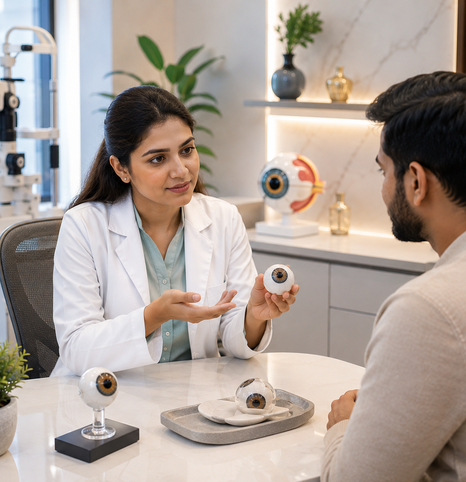
Artificial or ocular prostheses are custom-designed appliances crafted to restore natural appearance, support facial symmetry, maintain eyelid closure, and enhance emotional well-being.
Artificial or ocular prostheses closely resemble the natural eye in color, size, shape, and movement. While they do not provide vision, they restore facial aesthetics, address sunken orbital cavities, alleviate drooping lids, and maintain proper socket geometry.
Hand-painted iris striations and scleral tinting carefully replicate the unique characteristics of the patient's companion eye.
Precise impression molding ensures the prosthesis fills the orbital space evenly and supports natural palpebral aperture.
Provides anatomical structure to prevent socket contraction, supporting eyelid closure, fornices, and tissue stability.
Polished surfaces and tailored contours minimize friction, allowing synchronized tracking and enduring daily comfort.
Eye loss or severe damage can arise from various medical and traumatic circumstances requiring dedicated prosthetic rehabilitation.
Severe physical trauma, open globe injuries, or industrial accidents resulting in structural eye loss.
Surgical enucleation or evisceration required for intraocular tumours such as retinoblastoma or choroidal melanoma.
Developmental conditions such as anophthalmia (absence of one or both eyes) or severe microphthalmia present at birth.
Refractory endophthalmitis, panophthalmitis, or devastating infections where removal is necessary to preserve general health.
Restoring symmetry and appearance over a phthisical, blind, painful, or disfigured eye using scleral shells or custom appliances.
A thoughtfully crafted ocular prosthesis plays a vital multidimensional role in physical rehabilitation, personal confidence, and overall quality of life.
Assists individuals in feeling comfortable in social, educational, and professional settings by eliminating noticeable aesthetic asymmetries.
Restores natural volume to the ocular orbit, preventing the hollowed-in look and aligning eyelid contours with the companion eye.
Maintains the physical depth of conjunctival fornices, supports normal tear drainage pathways, and preserves muscular tone.
Tailored prosthetic services designed to address individual socket conditions, developmental needs, and long-term maintenance.
The prosthetic eye is custom fabricated from medical-grade materials and hand-painted to match the patient's companion eye in precise color, size, iris detailing, and contour.
Careful modification and alignment aimed at improving physical comfort, smooth synchronized tracking, and harmonious alignment with the natural companion eye.
Following recent eye loss or surgery, dedicated socket care utilizes conformers or interim prosthetic devices to retain socket volume, fornices depth, and structural shape.
Specialized developmental care for infants and growing children, featuring sequential socket expanders, frequent adjustments, and custom-sized prostheses tailored to cranial growth.
Routine professional resurfacing, deep cleaning, ultrasonic polishing, and periodic replacement to preserve high gloss, hygienic socket conditions, and wearing comfort.
There is no single fixed cost for an ocular prosthesis. Overall expenditure depends upon individual anatomical requirements, fabrication complexity, and required clinical sessions.
Custom-sculpted ocular prostheses, thin scleral shells, or interim conformers each require distinct manufacturing steps.
Contracted sockets, extensive scar tissue, or irregular fornices require specialized impression molding and modification.
Medical-grade Acrylic (PMMA) and biocompatible Silicone materials crafted for tissue tolerance and durability.
The meticulous clinical skill required for custom iris hand-painting, vascular detail placement, and personalized fit.
Selecting a dedicated prosthetic eye provider requires evaluating clinical expertise, fabrication techniques, and comprehensive aftercare support.
Specialized training and dedicated clinical focus in ocular rehabilitation and facial prosthetics.
Proven track record of managing adult trauma cases as well as delicate pediatric socket growth.
Individualized impression molding, biocompatible medical materials, and custom hand-painting.
Commitment to natural color replication, facial symmetry, and irritation-free long-term wear.
Thorough socket assessments, patient hygiene education, and structured follow-up schedules.
Clear guidance on prosthetic costs, periodic polishing protocols, and replacement timelines.
Some health insurance policies in India may cover ocular prostheses to some extent, particularly when medically necessary due to trauma, surgery, or underlying medical conditions.
Check if your health policy includes coverage for external prosthetic devices and reconstructive appliances.
Confirm whether pre-authorization or medical necessity letters from an ophthalmologist are required.
Understand coverage caps, exclusions, and out-of-pocket costs for elective cosmetic enhancements.
A structured, patient-centered timeline from preliminary clinical evaluation to ongoing prosthetic maintenance.
Comprehensive socket evaluation, tissue health check, fornices depth measurement, and color analysis of the companion eye.
Impression molding, hand-painting of the iris and sclera, precise curing of medical-grade PMMA, and fine polishing.
Trial insertion, edge refinement, contour modifications, movement checking, and patient insertion/removal training.
Periodic check-ups to assess socket integrity, evaluate tissue tolerance, and ensure seamless comfort.
Professional ultrasonic cleaning, surface repolishing, and planned replacement over the long term as required.
Early consultation with an ocularist or ophthalmologist supports optimal socket health, eases the fitting process, and helps preserve facial symmetry.
Prompt socket care after enucleation or trauma prevents fornix contraction and prepares the site.
Early pediatric intervention supports facial symmetry and cranial bone expansion as the infant grows.
Addressing cosmetic disfigurement, drooping lids, or sunken sockets with customized prosthetics.
Periodic professional polishing and adjustments when experiencing irritation, discharge, or loose fit.
Klarity Eye Care Hospital provides complete ocular prosthetic care, combining experienced ocularist guidance, dedicated fabrication techniques, and personalized after-delivery service.
Schedule a dedicated ocular prosthetic consultation with Klarity's experienced eye care team in Nirala Nagar, Lucknow.